
Von Tausendfüsslern, Tennisbällen & royalen EssgewohnheitenAemul*ae in Leeds
Was tun Wissenschaftlerinnen einer Universität in der vorlesungsfreien Zeit oder den Semesterferien, wenn die Lehre pausiert und die meisten Gremientermine wegfallen?
Sie recherchieren und lesen, schreiben Anträge, Artikel, Dissertationen oder Habilitationen, bereiten vielleicht bereits die Lehre und Veranstaltungen fürs Folgesemester vor und nehmen an Workshops, Tagungen oder Kongressen teil. Dies sind wertvolle Gelegenheiten, mit Forschenden aus ähnlichen, aber auch ganz verschiedenen, Fachbereichen ins Gespräch zu kommen (siehe Untertitel), ein Netzwerk aufzubauen, und zu pflegen. Welches Forum ist dafür geeigneter als der grösste Fachkongress Europas?
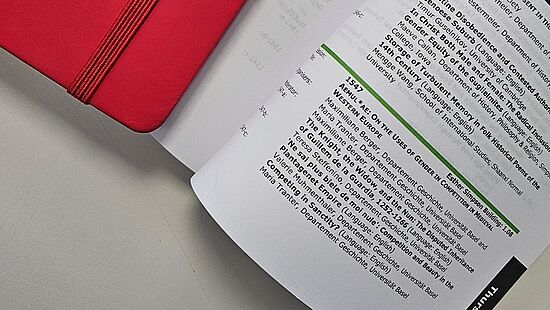
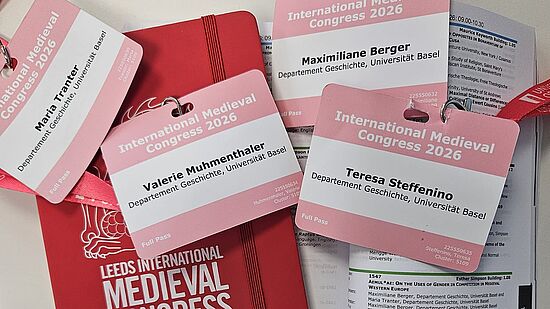
Im Juli reisten Dr. Maximiliane Berger, Dr. Maria Tranter, Teresa Steffenino und Valerie Muhmenthaler gemeinsam an den International Medieval Congress (IMC) nach Leeds, um genau das zu tun, denn Maximiliane und Maria organisierten die Session Aemul*ae: On the Uses of Gender in Competition in Medieval Western Europe:
(When) Do the Middle Ages mark gender? The use of typography (aemulAe, aemul*i, aemul:a) to make explicit the gender of the individuals involved is a phenomenon of the 21st century. Whether, where, and why gender is marked at all clearly depends on cultural context. This session will explore the uses of gender in the specific social situations wherein the distribution of resources is decided competitively. It is often assumed somewhat asymmetrically that when women compete, they do so as women, whereas the gender of men does not enter into contemporary or historiographical considerations. Competitive processes, which are to be distinguished from conflict in that they are focused on the object rather than the opponent, are important as they are a recurring medium through which to determine positions and access to resources in society. The papers in this session deal with competition for three desirable positions and/or resources, in the societies of early medieval England, the Plantagenet empire and 13th-century Iberia. They ask in what ways gender could play a part in the pursuit of sanctity, lordship, and beauty.
Fotos: Maximiliane Berger & Valerie Muhmenthaler
The Knight, the Widow and the Nun: The Disputed Inheritance of Guillem de la Guardia, 1252-1266
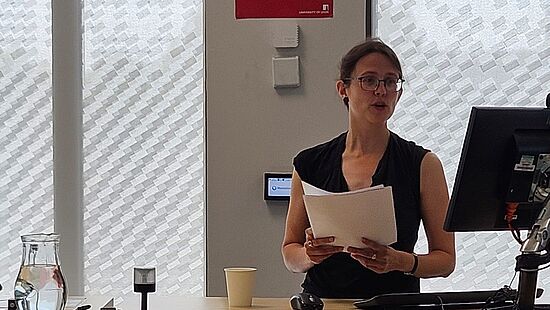
This paper sheds light on the entanglement of gender and competition in medieval Catalonia, focusing on the inheritance dispute after the death of Guillem de la Guardia: Although Guillem’s daughters, Mateua and Gueralda, were both constituted heirs, his nephew contested the will, arguing that, after Mateua’s death, Gueralda being a nun rendered the testator childless. Gueralda’s defense, however, also took up childlessness as an argument. In the competition between agnatic, marital, and monastic modes of inheritance, gender could be either a tool for exclusion or a source of legal, economic and memorial authority. (Teresa Steffenino)
Ne sai plus biele de moi nule – competition and beauty in the 12th century Plantagenet empire
During the second half of the twelfth century Plantagenêt Empire, personal appearance and beauty emerges as a central social strategy for the courtly elites and is given various functions and meanings within the frameworks of courtly interaction, self-representation and lordship practices. This paper discusses an episode from courtly literature concerned with human beauty and provides a compelling illustration of how beauty shaped the dynamics of competition within homosocial relationships in the courtly sphere. Thus, it argues that beauty was a powerful tool through which social hierarchies were negotiated, alliances forged, and dominance asserted in the competitive context of courtly life. (Valerie Muhmenthaler)
Competing in Sanctity?
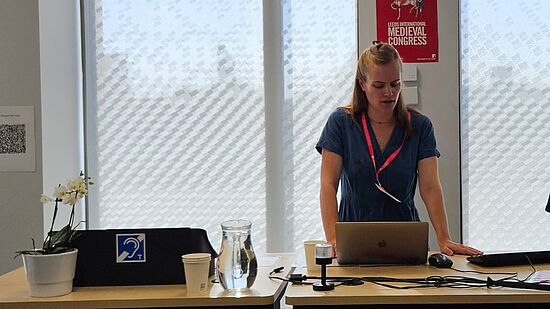
Sanctity may be thought to be an endless resource, but in tenth-century England, St Swithun was in competition not only with his older rival St Iodoc but also newly translated St Eadburgh for the prayers of the laity. Similarly, monasteries, who, it has been argued, through their very role of nurturing, protecting and teaching, take a female part within a paternal society, were repeatedly seen in competition for the possession of relics, irrespective of gender (or sex) of either the community or the saint. What role then does gender palay within the rivalry of these institutions? (Dr. Maria Tranter)