

/ Forschung / Yonatan Duran Maturana
What Does a Hummingbird Have to Do with Medieval Books of Hours?


There are some little birds so tiny that the entire bulk of some of them is smaller than the tip of a person’s thumb, and when plucked they are less than half that size. Besides being so small, this little bird flies with such speed and agility that, when seen in the air, its wings can no more be discerned than those of beetles or bumblebees… Without a doubt, because of the delicacy of its legs and feet, [hummingbird] resembled the little birds that [medieval] illuminators commonly depict in the margins [marginalia] of books of hours.
Put very simply, books of hours (horae) were Christian devotion, generally manuscript, intended primarily for lay worshippers. Historically, these books emerged in the thirteenth century from monastic models such as the psalter (the book containing the Bible’s 150 psalms) and the breviary (the liturgical book of prayers), and they reached the height of their circulation between the fourteenth and sixteenth centuries, especially in France, England, and the Low Countries—present-day Belgium, Netherlands, and Luxembourg. The term books of hours derives from the Hours of the Virgin, which were a series of prayers organized according to the canonical hours of the day. These books also commonly included a liturgical calendar, penitential psalms, litanies, suffrages of the saints, and the Office of the Dead. On the other hand, Marginalia were notes, comments or images placed along the edges of the text: real or fantastic animals, hybrids, small birds, monkeys, rabbits, musicians, peasants, clerics, obscene scenes, combats, and vegetation. Marginalia became widespread in Gothic illumination of the thirteenth and fourteenth centuries in the hands of medieval illuminators.1
But what does all this have to do with hummingbirds, which are only found in the Americas and remained unknown to the early modern Europeans until the sixteenth century? Perhaps a great deal; perhaps very little. As we will see, the answer concerns the way an unfamiliar animal such as the hummingbird could—or could not—enter the European world of that period. The earliest European morphological and ecological description of the hummingbird known to us was written by Gonzalo Fernández de Oviedo in his Sumario de la natural historia de las Indias (1526). I say “European” because the hummingbirds were well known to the Indigenous peoples of the New World: among the Nahuas, for example, it was called huitzitzilin; among the Maya, ts’unu’um; and in various Andean regions, q’inti or kinde.
By the time Oviedo was preparing his Sumario, many of the plants and animals of the New World had no exact counterparts in the classical natural histories. Neither Aristotle nor Pliny the Elder had known avocados, maize, tomatoes, pineapples, armadillos, iguanas, manatees, or hummingbirds. They represented striking novelties within European natural history and had to be interpreted through established categories, comparisons, and analogies. Oviedo’s Sumario described a remarkable number of birds unknown both to the classical naturalist tradition and to his European contemporaries; however, it did not illustrate a single one of them. By contrast, other New World animals, such as the iguana and the manatee, were selected for visual representation. This raises an important question: why did Oviedo illustrate some unfamiliar animals while leaving others only in textual-based description?
In the case of the hummingbirds, I argue that, despite the unfamiliarity of their plumage, form, or size, they did not destabilize the broader classificatory category of “bird,” which was already established within classical natural history. Aristotle’s Historia animalium distinguished animal groups through a combination of anatomical traits, ways of life, habitats, and modes of reproduction. In this context, birds constituted one of the principal categories of red-blooded animals (present-day vertebrates), forming a recognizable group due to their shared bodily organization: they were bipedal, winged, feathered, air-breathing, and egg-laying. Similarly, Pliny the Elder expanded this tradition in his Naturalis historia by drawing on ecological and morphological criteria, though from an encyclopedic point of view.2 Nevertheless, it is worth understanding genus and species here not as fixed taxonomic ranks in the modern sense. In Aristotelian natural history, these categories designated relative levels of generality, in which “bird” could function as a broad genus insofar as it grouped together animals with a common organization, while more particular forms were recognized within it.
Following this tradition, Oviedo did not identify the hummingbird with a preexisting species but made it intelligible at the more general level of “bird.” Their novelty, therefore, were specific rather than categorical, that is, they were an unfamiliar form of an already recognizable animal. Let us see. Oviedo placed the hummingbirds within the broad category of “bird” and within his readers’ horizon by evoking a familiar visual culture: the marginalia. The hummingbird—which Oviedo calls the pájaro mosquito (“mosquito bird”)—is described in these terms:
There are some little birds so tiny that the entire bulk of some of them is smaller than the tip of a person’s thumb, and when plucked they are less than half that size. Besides being so small, this little bird flies with such speed and agility that, when seen in the air, its wings can no more be discerned than those of beetles or bumblebees… Without a doubt, because of the delicacy of its legs and feet, it resembled the little birds that [medieval] illuminators commonly depict in the margins [marginalia] of books of hours.3
As we have seen, these marginal images (fig. 1) formed part of a widely shared repertoire in which the natural world was represented through a set of recognizable forms rather than through strict naturalistic observation. Oviedo’s analogy therefore activates this visual culture already familiar to his readers, and instead of requiring a new image, his description asked them to retrieve an existing mental image and adapt it to this New World bird. The analogy supplied a recognizable visual representation through which an otherwise unfamiliar creature could be imagined. In this case, words performed the classificatory and visual function that a new illustration would otherwise have had to fulfill.
From this perspective, an unfamiliar bird could still be classified as a bird even when its particular plumage, form, or size had no precedent. Consequently, certain unfamiliar species could be made comprehensible by placing them within an already circulating repertoire of visual and descriptive knowledge, making a new illustration likely unnecessary. This contrast is especially clear in the case of the iguana. When Europeans first encountered it in the sixteenth century, the iguana appeared genuinely ambiguous and perplexing, “almost a symbol of the astonishing novelty of American species.”4 That the iguana’s assimilation was less stable, is shown by the way different accounts intepreated it: a snake for Christopher Columbus and Amerigo Vespucci, a lizard for Álvarez de Chanca, and a crocodile for Peter Martyrm.
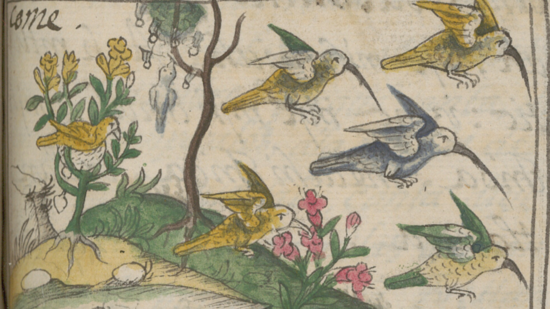
The decision of whether to depict animals visually is best understood by comparing different accounts. Other Hispano-American accounts of New World nature did include illustrations of hummingbirds. A revealing counterpoint to Oviedo’s Sumario is Bernardino de Sahagún’s Historia general de las cosas de Nueva España (ca. 1575–1577), known as the Florentine Codex: an encyclopedic manuscript compiled in New Spain through the collaboration among Franciscan scholars, tlacuiloque (painters), scribes, and Nahua informants.5 Like Sumario, the Florentine Codex sought to make unfamiliar New World birds intelligible (fig. 2). Unlike the Sumario, however, it did so through carefully executed images accompanied by names and descriptions in Spanish and Nahuatl.
The difference between the two accounts of the New World lies not simply in the fact that one contains images and the other does not, but in the function, each attribute to them. If my suggestion is correct, Oviedo recognized the value of visual representation—as he does in several parts of his Sumario—but used it selectively. When a text-based analogy, such as the comparison between the hummingbird and the little birds in marginalia, could make an unfamiliar animal intelligible through an already familiar visual repertoire, a new illustration may have seemed less necessary. The tlacuiloque of the Florentine Codex, by contrast, worked from a different tradition: Mesoamerican painting, in which the image functioned not merely as a supplement to the text, but as a form of knowledge closely articulated with the word. For this reason, every bird—whether or not it was new to early modern Europeans—received an image, a Nahua name, and a description. The difference, then, is not that Oviedo denied images epistemic value, but that the two works integrated them differently into their respective ways of describing and ordering the New World.
Finally, comparing Oviedo’s Sumario with the Florentine Codex suggests that the presence or absence of illustrations cannot be explained only by the novelty of New World animals. Rather, the two works assigned different epistemic functions to the images. In Oviedo’s Sumario, illustrations were necessary when text-based analogies could not situate organisms within an accepted visual and classification framework. This can be seen in the case of animals such as iguanas and manatees, for which the same strategy was ineffective. Nevertheless, topic belongs to a larger story that my dissertation seeks to develop. For now, it is sufficient to observe that the hummingbird could enter the European horizon of its time through the broad and still operative category of “bird,” reinforced by analogy with small birds in marginalia. For the iguana, however, that estrategy was more problematic and therefore less accessible.
References
- On the books of hours, see Virginia Reinburg, French Books of Hours: Making an Archive of Prayer, c.1400–1600, 1st ed. (Cambridge University Press, 2012), doi.org/10.1017/CBO9781139030496. On marginalia, see Michael Camille, Image on the Edge: The Margins of Medieval Art (Harvard University Press, 1992); Lilian M. C. Randall, Images in the Margins of Gothic Manuscripts (University of California Press, 1966), doi.org/10.2307/jj.8500990.
- The historiography on classical natural history is vast; however, for a comprehensive account on classical birds classification specifically, see J. J. Hall, “The Classification of Birds, in Aristotle and Early Modern Naturalists (I),” History of Science 29, no. 2 (1991): 111–51, doi.org/10.1177/007327539102900201; Erwin Stresemann, Ornithology, from Aristotle to the Present, ed. G. William Cottrell, trans. Hans J. Epstein and Cathleen Epstein (Harvard University Press, 1975).
- “Hay unos pajaritos tan chiquitos, que el bulto todo de unos es menor que la cabeza del dedo pulgar de la mano, y pelado es más de la mitad menor de lo que es dicho; es una avecica que, demás de su pequeñez, tiene tanta velocidad y presteza en el volar, que viéndola en el aire no se le pueden considerar las alas de otra manera que las de los escarabajos o abejones… Sin duda, por la delicadeza de sus patas y pies, se asemejaba a los pajaritos que los iluminadores [medievales] suelen representar en los márgenes [marginalia] de los libros de horas”: Gonzalo Fernández de Oviedo, Sumario de la natural historia de las Indias (Toledo; Ramón de Petras, 1526), Chap. Pajaro Mosquito, fol xxix.
- Antonello Gerbi, Nature in the New World: From Christopher Columbus to Gonzalo Fernández de Oviedo, trans. Jeremy Moyle (Riccardo Ricciardi Editore, 1975; repr., University of Pittsburgh Press, 1986), 419.
- On the manuscript’s English version and its designation as the “Florentine Codex,” see Bernardino de Sahagún, Florentine Codex: General History of the Things of New Spain, trans. Arthur James Outram Anderson and Charles E. Dibble, 13 vols., Monographs of the School of American Research (School of American Research, 1982).
Sources
Camille, Michael. Image on the Edge: The Margins of Medieval Art. Harvard University Press, 1992.
Fernández de Oviedo, Gonzalo. Sumario de la natural historia de las Indias. Toledo. Ramón de Petras, 1526.
Gerbi, Antonello. Nature in the New World: From Christopher Columbus to Gonzalo Fernández de Oviedo. Translated by Jeremy Moyle. Riccardo Ricciardi Editore, 1975. Reprint, University of Pittsburgh Press, 1986.
Hall, J. J. “The Classification of Birds, in Aristotle and Early Modern Naturalists (I).” History of Science 29, no. 2 (1991): 111–51. https://doi.org/10.1177/007327539102900201.
Randall, Lilian M. C. Images in the Margins of Gothic Manuscripts. University of California Press, 1966. https://doi.org/10.2307/jj.8500990.
Reinburg, Virginia. French Books of Hours: Making an Archive of Prayer, c.1400–1600. 1st ed. Cambridge University Press, 2012. https://doi.org/10.1017/CBO9781139030496.
Sahagún, Bernardino de. Florentine Codex: General History of the Things of New Spain. Translated by Arthur James Outram Anderson and Charles E. Dibble. 13 vols. Monographs of the School of American Research. School of American Research, 1982.
Sahagún, Bernardino de. Historia General de Las Cosas de Nueva España. Biblioteca Medicea Laurenziana, MSS Med. Palat. 218–220, 1575.
Stresemann, Erwin. Ornithology, from Aristotle to the Present. Edited by G. William Cottrell. Translated by Hans J. Epstein and Cathleen Epstein. Harvard University Press, 1975.