
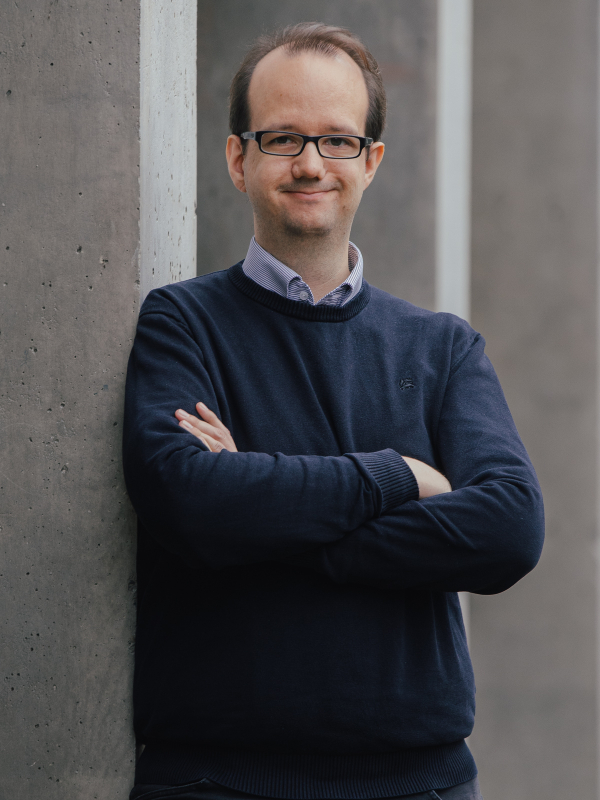
Dr. des. Kai Johann Willms
Assistent für Osteuropäische Geschichte (Professur Schenk)
Büro
Hirschgässlein 21
4051 Basel
Schweiz
Hinweise
Büro 409
Curriculum Vitae
Since 02/2024: Postdoctoral assistant at the Chair for East European History, University of Basel
11/2023: Defense of the doctoral thesis "Transkulturelles Wissen im Ost-West-Konflikt: Das polnische Exil und die amerikanische Osteuropaforschung, 1939–1989" [Transcultural knowledge in the Cold War: Polish émigrés and East European Studies in the United States, 1939–1989] at LMU Munich
08/2021–01/2024: Doctoral assistant at the Chair for East European History, University of Basel
01–03/2020: Visiting PhD Scholar at the Department of History, Columbia University, New York
11/2017–07/2021: Research associate and doctoral candidate at the Graduate School for East and Southeast European Studies, LMU Munich
09/2014–12/2019: Research assistant at the Institute for the Culture and History of Germans in Northeast Europe (Northeast Institute), Lüneburg
10/2015–02/2016: Exchange student (Erasmus) at the University of Warsaw
04/2014–10/2016: M.A. studies in Modern European History at HU Berlin
10/2012–02/2013: Student assistant (tutor) at the Chair for Modern and East European History, University of Freiburg
10/2010–09/2013: B.A. studies in History and Political Science at the University of Freiburg
Current research project (second book)
Metropolises of the Periphery: Imperial Visions and Local Dynamics of Urban Modernisation in Vilnius, Tbilisi and Toshkent, 1865–1914
Cities have long attracted the interest of historians as places where social change becomes particularly visible. Especially with regard to the age of urbanisation in the nineteenth and early twentieth centuries, cities have been explored as laboratories of modernisation where new visions of social and political order were discussed and put into practice: Social historians studied cities as sites of an emerging modern class society and social conflict; cultural historians have been interested in cities as places of cultural diversity, nation-building, and struggles over representation. More recently, urban historians have increasingly focused on how the material, spatial, and infrastructural dimensions of the city shaped these social and cultural conflicts associated with ‘modernisation’.
In imperial peripheries, urban ‘modernisation’ acquired a particular significance because it shaped relations between imperial administrators and local actors. Imperial administrators could use urban development projects to assert their supposed civilisational superiority and thus to legitimise imperial rule. Local actors, however, could appropriate and reshape such projects, claim their own forms of ‘modernisation’, challenge imperial definitions of civilisation, or reject the concept of ‘modernisation’ altogether.
The project examines these processes in the late Russian Empire by comparing the development of three cities: Vilnius, Tbilisi, and Toshkent. While the three cities were similar in terms of population size, ethnic diversity, and their function as political centres in geopolitically exposed parts of the empire, they represent three imperial peripheries where the relationship between imperial and local actors is often depicted in radically different ways. Russian rule in Central Asia, on the one hand, is commonly understood as a classical case of colonialism: Imperial administrators invoked the idea of a civilising mission and presented urban development as evidence of the legitimacy of imperial rule. In the Western borderlands, on the other hand, Russian imperialism has more often been interpreted as an impediment to processes of ‘modernisation’ that could potentially threaten imperial stability. The South Caucasus, finally, can be characterised as a semicolonial space where both dynamics were present simultaneously. Comparing these three cases makes it possible to examine whether such distinctions remain convincing when the focus shifts from large-scale imperial categories to everyday urban practices and interactions.
Relying on administrative sources, the local press, and contemporary travelogues, the project investigates three interconnected arenas in which claims to urban modernity were articulated and negotiated: urban planning and infrastructural development; urban biopolitics, particularly healthcare and public hygiene; and the emergence of an urban public sphere and associated practices of censorship. Rather than treating imperial and local actors as homogeneous or assuming a one-directional diffusion of ‘modernisation’ from the imperial centre to the periphery, the project traces processes of cooperation and appropriation as well as contestation and conflict.
In doing so, the project reconstructs the emergence of urban modernity in the late Russian Empire’s borderlands as a product of entangled imperial and local practices. It thereby seeks to reassess the differentiated character of Russian imperial rule and to contribute to a more nuanced understanding of the empire’s coloniality across its European and Asian peripheries.
Completed research project (PhD thesis)
Transcultural Knowledge in the Cold War: Polish Émigrés and East European Studies in the United States, 1939–1989
The beginnings of the Cold War posed a challenge to political decision makers in the United States: Until World War II Eastern Europe had been a marginal field of research in American academia. In order to overcome this lack of expertise, new institutes and research centers for Eastern European Studies were established and generously funded. Since there were only few domestic experts, émigré scholars from Eastern and Central Europe constituted a vital human resource in this field. Many émigré scholars gratefully accepted these career opportunities, but they did not confine themselves to the role of knowledge suppliers for American politics; in many cases they pursued an agenda of their own. Already during World War II Polish émigré scholars founded research institutions and created transnational networks in order to promote their own historical narratives and mental maps within the public spheres of the Western world. Drawing on the expanding research on the significance of migration for the production and circulation of knowledge and ideas, the project analyzes the role of Polish émigré scholars in the US as agents of a cultural transfer: What influence did they exert on the American image of Eastern Europe in the context of the Cold War? To what extent did they adopt, while assimilating into American society, ideas and knowledge from their new environment? How were the émigré scholars’ activities perceived in Poland before and after 1989? By pursuing these questions, the project contributes to a better understanding of the role of intellectual border crossers at the time of the Cold War and at the same time reflects on the epistemological question how the scholarly production of knowledge is shaped by the writer’s social context.
- Urban history of late Imperial Russia
- Nation-building in the borderlands of the Russian Empire
- History of migration and exile from East Central Europe
- History of the humanities and social sciences in East Central Europe
- History of East European Studies and Western imaginations of "Eastern Europe"
Journal articles and book chapters:
“Émigré Scholars as ‘Agents of Westernisation’? Comparative Reflections on the Cases of Poland and Germany”, Yearbook of the Institute of East-Central Europe 23:4 (2025), 245–264, https://doi.org/10.36874/RIESW.2025.4.10.
"A 'Clash of Definitions'? Polish Émigré Scholars and the Cold War Discourse of Western Civilization", The Exile History Review 3 (2024), 75–93, https://doi.org/10.31743/ehr.17994.
"Between Integration and Institutional Self-Organisation: Polish Émigré Scholarship in the United States, 1939–1989", in Stefan Berger, Philipp Müller (eds.), "Dynamics of Emigration: Émigré Scholars and the Production of Historical Knowledge in the 20th Century" (New York: Berghahn Books, 2022), 124–138, https://doi.org/10.1515/9781800736108-008.
"Das Ende der Imitation oder ein neuer Klassenkonflikt? Zwei paradigmatische Erklärungen für die Krise der liberalen Weltordnung", Geschichte und Gesellschaft 47:2 (2021), 320–337, https://doi.org/10.13109/gege.2021.47.2.320.
Blog entries:
"Die Atombombenabwürfe auf Nagasaki und Hiroshima im August 1945: 'Global Moments'? Teil 1", Zeitgeschichte online, 1 April 2017, http://www.zeitgeschichte-online.de/themen/die-atombombenabwuerfe-auf-nagasaki-und-hiroshima-im-august-1945-global-moments (with Martin Wagner, Susanne Quitmann and Helge Jonas Pösche).
Book reviews:
Jan Surman (ed.), “Science Interconnected: German-Polish Scholarly Entanglements in Modern History” (Marburg: Herder-Institut, 2022), Zeitschrift für Ostmitteleuropa-Forschung 74:2 (2025), 271–273, https://doi.org/10.25627/202574211676.
Friedrich Cain, "Wissen im Untergrund: Praxis und Politik klandestiner Forschung im besetzten Polen (1939–1945)" (Tübingen: Mohr Siebeck, 2021), Sehepunkte 24:4 (2024), 15 April 2024, https://www.sehepunkte.de/2024/04/36966.html.
Jessie Labov, "Transatlantic Central Europe: Contesting Geography and Redefining Culture Beyond the Nation" (Budapest: CEU Press, 2019), H-Soz-Kult, 8 April 2021, http://www.hsozkult.de/publicationreview/id/reb-28966.
Łukasz Mikołajewski, "Disenchanted Europeans: Polish Émigré Writers from Kultura and the Postwar Reformulations of the West" (Oxford: Peter Lang, 2018), Jahrbücher für Geschichte Osteuropas / jgo.e-reviews 10:3 (2020), 60–62, https://www.recensio.net/r/e93017b849b14e05b2f97bf0995a06ec.
Ralph Schattkowsky, "Osteuropaforschung in Polen 1918–1939" (Wiesbaden: Harrassowitz, 2019), H-Soz-Kult, 30 June 2020, http://www.hsozkult.de/publicationreview/id/reb-29533.
Maria Zadencka, Andrejs Plakans, Andreas Lawaty (eds.), "East and Central European History Writing in Exile 1939–1989" (Leiden: Brill, 2015), Jahrbücher für Geschichte Osteuropas / jgo.e-reviews 8:4 (2018), 83–87, https://www.recensio.net/r/6388ffb6cb564aca978fc070d2b317bf.
Benjamin Conrad, "Umkämpfte Grenzen, umkämpfte Bevölkerung: Die Entstehung der Staatsgrenzen der Zweiten Polnischen Republik 1918–1923" (Stuttgart: Steiner, 2014), Nordost-Archiv 26 (2017), 185–187, https://doi.org/10.15463/rec.1335355409.
Conference reports:
"Physical Violence and State Legitimacy in Late Socialism: Final Conference" (Berlin, 27 February – 1 March 2014), H-Soz-Kult, 23 June 2014, http://www.hsozkult.de/conferencereport/id/tagungsberichte-5436 (with Jane Freeland).
"Biopower and Physical Violence: Embodied Experiences in Communist Europe" (Potsdam, 24 January 2014), H-Soz-Kult, 15 April 2014, http://www.hsozkult.de/conferencereport/id/tagungsberichte-5308.
Memberships:
Deutsche Gesellschaft für Osteuropakunde e.V. (DGO)
Schweizerische Akademische Gesellschaft für Osteuropawissenschaften (SAGO)
Verband der Osteuropahistorikerinnen und -historiker e.V. (VOH)
Osteuropa-Forum Basel
Awards:
| 2025 | Historicum Award of the Association of Alumni, Friends and Supporters of the Historical Seminar at LMU Munich for the doctoral thesis |
| 2025 | Fritz Theodor Epstein Award of the German Association of Historians of Eastern Europe (VOH) for the doctoral thesis |
| 2024 | Scientific Award of the Ambassador of the Republic of Poland in Germany for the doctoral thesis |
| 2017 | Johann Gustav Droysen Award of the Department of History at HU Berlin for the Master's thesis |
Grants and fellowships:
| 2026 | Residency Fellowship at the Vilnius Research Centre and at the Georgia Office of the Max Weber Foundation's Network Eastern Europe |
| 2024 | Short-term grant of the Max Weber Foundation – Georgia Branch for archival research in Georgia |
| 2024 | Grant of the Voluntary Academic Society Basel (FAG) for archival research in Lithuania and Georgia |
| 2020, 2022 | Short-term grants of the German Academic Exchange Service (DAAD) for archival research in the United States and Canada |
| 2017 | Humboldt Research Track Scholarship, funded by HU Berlin |
| 2015-2016 | Erasmus+ grant for an exchange semester at the University of Warsaw |
| 2011-2016 | Scholarship of the German Academic Scholarship Foundation (Studienstiftung des deutschen Volkes) |