

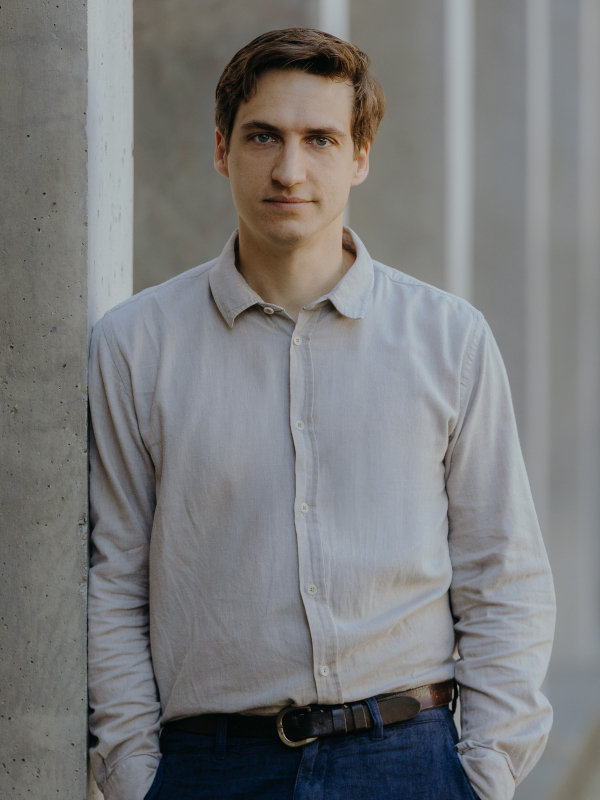
Prof. Dr. Fabian Baumann
Professor (SNF-Professur Baumann)
Office
Hirschgässlein 21
4051 Basel
Schweiz
Bio
I am a historian of nationalism, empire, and democracy in Russia, Ukraine, and East Central Europe. My book Dynasty Divided: A Family History of Russian and Ukrainian Nationalism, published by NIU Press/Cornell University Press, was awarded the 2024 W. Bruce Lincoln Book Prize for an author’s first published monograph of exceptional merit and lasting significance for the understanding of Russia’s past, as well as the 2025 Alexander Nove Prize in Russian, Soviet, and Post-Soviet Studies. Tracing the story of a family that included both Russian and Ukrainian nationalists, Dynasty Divided analyzes what prompted nineteenth-century intellectuals to identify with either one or another imagined community. I argue that these men and women consciously chose a political position and only then began their self-fashioning as members of a national community, defying the notion of nationalism as a consequence of a pre-existing ethnicity. I have also worked on a postdoctoral research project about “banal” forms of nationalism and the promotion of republican statehood in late Soviet Ukraine.
My current research project focuses on the prosecution of purported traitors and enemies of the state in the First Czechoslovak Republic. Forged from disparate post-imperial territories after the end of World War I, Czechoslovakia was a precarious republic threatened by various authoritarian currents among its population. Political groups of dubious state loyalty included Sudeten German nationalists, Hungarian irredentists, Slovak autonomists, Czech fascists, and communists. Trying to protect national unity and the “democratic-republican order,” the state enacted far-reaching legislation to act against its enemies, most notoriously the 1923 Law for the Protection of the Republic. At the same time, trials against purported traitors and enemies of the state often created an opportunity for societal debates about the meaning of loyalty and enmity towards the republic, laying bare the anxieties of the state’s defenders and the hopes of its enemies. Shedding light on the intertwined dynamics of state-building and disloyalty, the project will contribute to an ongoing reassessment of the region’s most stable democracy and the precarious efforts to protect it from authoritarian encroachment.
I am also the co-editor, with Olena Palko and Börries Kuzmany, of the first English-language Handbook of Ukrainian History, which is scheduled to be published by Oxford University Press in 2028.
Curriculum Vitae
2026-: SNSF Assistant Professor, University of Basel
2023-2026: Research Associate, Heidelberg University
2023: SNSF Postdoc.Mobility Fellow, RECET, University of Vienna
2021–2022: SNSF Postdoc.Mobility Fellow, University of Chicago
2020–2021: Assistant Lecturer, University of Basel
2020: PhD in East European History, University of Basel (summa cum laude)
2016–2020: SNSF Doc.CH Fellow, University of Basel
2014: M.Phil in Slavonic Studies, University of Oxford
2012: BA in Russian and English Language, Literature, and Civilization, University of Geneva
Publications
Ukrainian translation: Rozdilena dynastiia: Rodynna istoriia rosiis’koho i ukraïns’koho natsionalizmiv, translated by Les’ Belei (L’viv: Lokal’na istoriia 2025).
“Ukraine in Rot. Imperiales Gewaltregime und Institutionalisierung der ukrainischen Nation,” Religion & Gesellschaft in Ost und West 9 (2023), 11–14.
“Von Krieg zu Krieg: Historische Ukraineforschung seit 2014,” Osteuropa 72, no. 1–3 (2022): 309–318.
“Revisiting Soviet Modernity in the non-Russian Periphery,” Euxeinos. Culture and Governance in the Black Sea Region 12, no. 34 (2022) (with Olena Palko).
“Einseitiger Einheitswunsch – Putins neueste Geschichtslektion,” Religion & Gesellschaft in Ost und West 9 (2021), 3–5.
“Enthusiasm, Disillusionment, and Enemization on the Pages of Kievlianin in the Spring of 1917.” In Franziska Schedewie, Dennis Dierks, eds., Imagining the Future in Russia’s February Revolution (Leiden: Brill, forthcoming 2026).
“From National Indifference to Indifferent Nationality? The Ukrainian Masses and Nationhood in the Russian Empire and the Soviet Union.” In Petru Negură et al., eds., Nationalism From Below in the East European and Soviet Borderlands: Popular Responses to Nation-Building, 1900-1940. (London: Bloomsbury, 2025), 23–43.
“Hiking Boots and Peasant Shirts: National Science, Self-Fashioning, and the Ukrainophile Tradition of Scholarly Travel”. In Jörn Happel et al., eds., Discovering, Surveying, Ordering: Expeditions in the Long Nineteenth Century (London: Routledge, 2024), 111–139 (with Martin Rohde).
“Russischer und ukrainischer Nationalismus und die Ursprünge anti-ukrainischer Feindbilder im 19. Jahrhundert.” In Fraziska Davies, ed., Die Ukraine in Europa: Traum und Trauma einer Nation (Darmstadt: wbg Theiss, 2023), 82–100.
“Between Empires: Ukraine in the Nineteenth Century.” In Olena Palko and Manuel Férez Gil, eds., Ukraine’s Many Faces: Land, People and Culture Revisited (Bielefeld: Transcript, 2023), 83–90.
“Entre imperios: La Ucrania al siglo XIX.” In Olena Palko and Manuel Férez Gil, eds., Descrubriendo Ucrania: su pueblo, su historia, y su cultura (Beccar, Argentina: Poliedro Editorial de la Universidad de San Isidro, 2022), 36–41.
Review of Börries Kuzmany, Vom Umgang mit nationaler Vielfalt. Eine Geschichte der nicht-territorialen Autonomie in Europa, Jahrbücher für Geschichte Osteuropas, vol. 73, no. 1, 2025, 145–47.
Review of Serhiy Bilenky, Laboratory of Modernity: Ukraine between Empire and Nation, 1772-1914, Acta Poloniae Historica, vol. 130, 2024, 127–32.
Review of John Connelly, From Peoples into Nations: A History of Eastern Europe, Jahrbücher für Geschichte Osteuropas, vol. 70, no. 1–2, 2022, 227–29.
Review of Stephan Rindlisbacher and Dimitri Tolkatsch (eds.), Die heutige Ukraine und ihre sowjetischen Wurzeln, Jahrbücher für Geschichte Osteuropas, vol. 69, no. 4, 2021, 697–700.
Review of Trevor Erlacher, Ukrainian Nationalism in the Age of Extremes. An Intellectual Biography of Dmytro Dontsov, Jahrbücher für Geschichte Osteuropas, vol. 69, no. 4, 2021, 676–78.
“Er befragte das Stör-Orakel,” FAZ, 17 December 2025, 5.
“Warum das Studienfach Osteuropäische Geschichte so politisch ist,” Swissinfo, 24 September 2025. (English, Spanish, Portuguese, Chinese, and Russian versions available on website.)
Interview with Modul’ znan’, Radio Kul’tura (Ukraine), 19 September 2025.
“The Eurasian Knot Podcast: A Tale of Two Nationalisms, 16 December 2024.
“IR Thinker Youtube Channel: Russian and Ukrainian Nationalism,” 2 December 2024.
“Krieg in der Ukraine – wie weiter?” Interview with Telebasel, 15 December 2023.
“Ein Keil geht durch die Kiewer Familie,” NZZ, 19 August 2023, 44–45.
“Choosing Ukrainian, then and now,” Eurozine, 8 May 2023.
Welsh Translation: “Dewis iaith: Ai dyfodol unieithog sydd i Wcráin?,” O’r Pedwar Gwynt, 24 May 2023.
“Das Märchen vom Marionettenstaat,” NZZ, 13 April 2023, 32.
John Vsetecka, Spotlight Interview with Fabian Baumann, H-Ukraine, 11 March 2023.
“Ein Folterlager im heutigen Europa,” Republik, 3 January 2023.
“Im Grenzland der Geschichte,” Republik, 12 September 2022.
“‘Anti-Russland’? Die Ukraine als politisches Projekt,” Geschichte der Gegenwart, 6 April 2022.
“Die innere Logik des Krieges,” WOZ, 31 March 2022, 10.
“Cliocast #19 mit Fabian Baumann: Diverging Paths,” 28 March 2022.
“Warum Entnazifizierung? Wird die Ukraine von Nazis regiert?” Dekoder, 7 March 2022.
“Putins Vorgehen hat auch mich überrascht,” interview with Regionaljournal Basel, Radio SRF, 1 March 2022.
“Russisch-ukrainische Beziehungen: Putins verzerrtes Geschichtsbild,” SonntagsBlick, 27 February 2022.
“Basler Historiker zur Ukraine: ‘Die Menschen kämpfen ums Überleben,’” interview with Telebasel, 24 February 2022.
“Für Putin ist es sein letzter Cordon sanitaire,” interview with Nebelspalter, 23 February 2022.
“Als Genf das Zentrum der Ukraine war,” NZZ Geschichte 1 (2021), 87–95.
“Geschichtspolitik mit dem Holzhammer,” Geschichte der Gegenwart, 7 December 2016.
“Propaganda, Wahrheit und der Westen: Was tun?,” Medienwoche, 12 March 2015.
“Natürlich nationalkonservativ,” Medienwoche, 13 January 2015.