SNF-Project by Dr. Claire NicolasThe Contested Politics of Global Sisterhood: Race, Sex, and the Young Women's Christian Association in Africa (1878-1971)
This image is part of the World YWCA Archives (Geneva, Switzerland). Please do not reproduce, edit or crop this image.
The Project
The Contested Politics of Global Sisterhood: Race, Sex, and the Young Women's Christian Association in Africa (1878-1971)
In the early 1910s, Adelaide Casely-Hayford became a leading activist in Sierra Leone, advocating for feminism and racial pride in Freetown. In 1919, Esther Fahmi Wisa participated in a women’s march that played a momentous role in the revolt against British rule in Egypt. In 1953, Evelyn Amarteifio established the influential National Federation of Gold Coast Women in Ghana. These cosmopolitan and literate African women shared common ground: they all shaped radical nationalist, anticolonial, and feminist movements that changed the African political landscape in the 20th century. But they also shared an unexpected feature. They were all involved in the World–Young Women's Christian Association (YWCA), an international organisation more famous for its imperial and conservative legacy than its radical views. How can we reconcile these two contradictory stories? How does the history of the YWCA—at the crossroads of women-led British missionary work, American philanthropy, and Geneva-based liberal world order—align with that of African anticolonial feminist activists?
From its British overseas committees set up in 1878 to its first African-based conference held in Accra in 1971, the YWCA was used by bourgeois women to oversee the sexual behaviour and welfare of young single women living in urban settings, and to advance conservative ideas about gender, sexuality, class, and race. However, the literature on women’s rights movements argued that local African activists relied on the YWCA to build alliances between women, beyond class or race, in a common fight against colonial or local authorities, paving the way for the internationalisation of African women’s rights movements. As this prolific body of scholarship discussed whether Western women-led structures supported imperialism or African women’s emancipation—and sought to define this ‘Global Sisterhood’—the YWCA became central to academic conversations about international philanthropy, women’s activism, and youth movements. Yet, scholars did not delve into the history of the YWCA at global scale, let alone in Africa, nor illuminated what the organisation meant for African women. This project will be the first in-depth historical inquiry to chart what aspects of the gender and colonial orders were challenged by the YWCA and its African members, and how their embrace of conservative views affected their activism and alliances. It will explore how African women positioned themselves with regards to the two primary targets of the YWCA: sexuality and social welfare. Through this, the project will assess how the original YWCA’s class-based and gendered focus on sexuality and welfare was transformed by the racialised colonial setting, eventually informing policies and positions laid down at global scale.
The project takes place at the University of Basel department of history, and is aided by international partnerships with France, United Kingdom, and Germany. It is based on research in archival centres across the world and uses innovative digital humanities tools to analyse the Africa-related YWCA network. The project uses a cross-scale approach: from global history to in-depth focus on international meetings, transnational actors’ trajectories, and two key African associations (South Africa and Ghana). This will inform how changing ideas about women’s rights and Global Sisterhood intertwined and converged at global scale, thus challenging the analytical distinction between radical emancipatory politics and conservative transimperial faith-based movements. Overall, this project offers a unique perspective on the history of international organisations, from the vantage point of African women. This shift in focus illuminates the history of faith-based international movements, the history of African women’s rights activists, and that of the contested politics of Global Sisterhood.
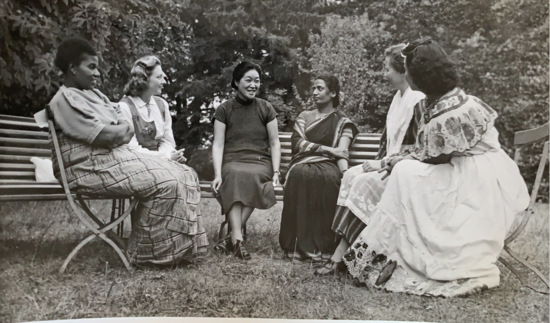
Picture: Annie Baëta (Gold Coast), Else Joranger (Norway), Feng-Ying Niu (China), Ahilia Iswaraiya (India), Esther Svensson (Sweden), and Luz Hayala (Mexico) chatting during a leadership training course, 1949. Box Photographs - World YWCA Meetings.
This image is part of the World YWCA Archives (Geneva, Switzerland). Please do not reproduce, edit or crop this image.
Conference


African Women Shaping the World: Activism, Networks and Connections (1920s-1970s)
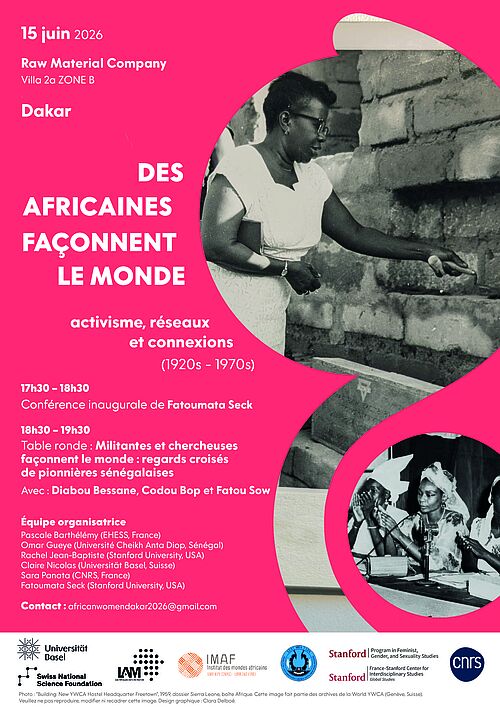
The Conference African Women Shaping the World: Activism, Networks, and Connections (1920s-1970s) was held in Dakar in June 2026, at Raw Material Company. This conference combined a two-days writing workshop and a public conference, both dedicated to African feminisms, transnational networks, and women’s engagement in struggles for rights. This double event sought to highlight African women’s role in shaping transnational networks while enriching the histories of global feminism and Pan-Africanism, African and global history, and twentieth-century feminist thought.
The workshop aimed both to contribute to the longue durée history of African women’s rights struggles and African feminisms and to expand our understanding of the significance of international and transnational relationships between African women activists and international women’s organizations. Research on these issues is currently thriving, and the workshop contributes to its development by fostering connections among researchers working on these topics across Africa, Europe, and North America. The workshop gathered 30 scholars, whose works ranged from faith-based internationalism to the legacy of the UN decade for women, and West African market women regional connections. The full programme available in English and French.
The public event opened with an inaugural lecture by Fatoumata Seck, from Stanford University. A specialist of the Senegalese left-wing movements, she highligted African women’s international activism. This was followed by a panel discussion entitled “Activists and researchers shape the world: intersecting perspectives of Senegalese pioneers”, bringing together three Senegalese activists and knowledge producers from different generations: Diabou Bessane (journalist, director of Les mamans des indépendances), Codou Bop (founding member of the African Feminist Forum, revolutionary movements specialist), and Fatou Sow (sociologist, gender studies specialist). This gathering offered a rich space for dialogue between history, research, and contemporary practices of African feminisms.
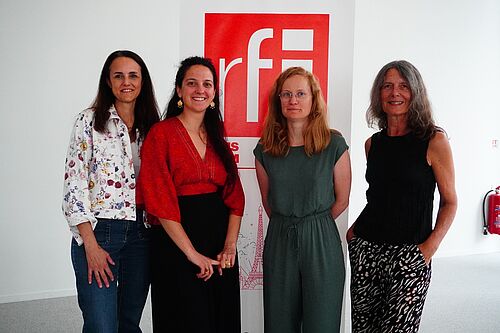
This event stemmed from a collaboration among scholars from different generations and institutions in France, Senegal, Switzerland and the United States. The team includes two scholars from Stanford University (Rachel Jean-Baptiste and Fatoumata Seck), Pascale Barthélémy from EHESS in Paris, Omar Gueye from Cheikh Anta Diop University in Dakar, Sara Panata from the National Center of Scientific Research (CNRS) in Bordeaux, and Claire Nicolas, from the University of Basel. It was hosted at Raw Material Company, a cultural space in Dakar working to foster growth of intellectual creativity in Africa through a trans-disciplinary approach. To facilitate smooth discussions across language barriers, the conference featured simultaneous interpretation into English and French.
Pictures: Kerry Etola Viderot @ Raw Material Company