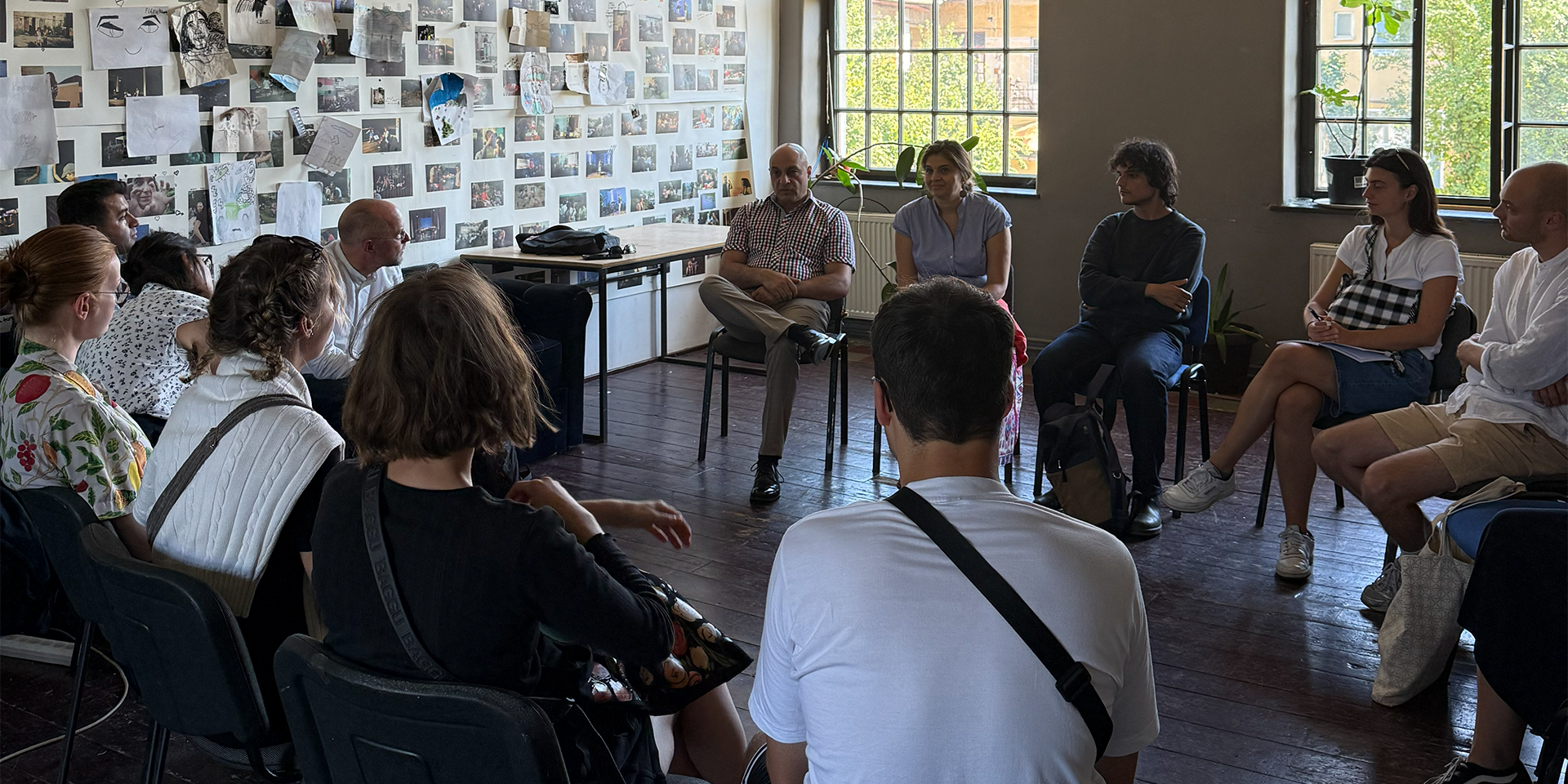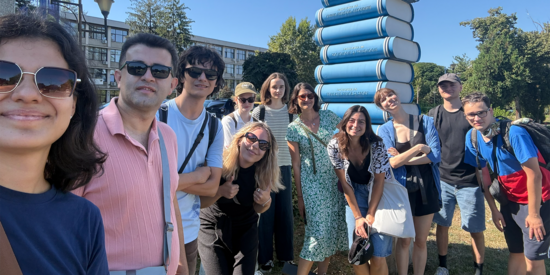
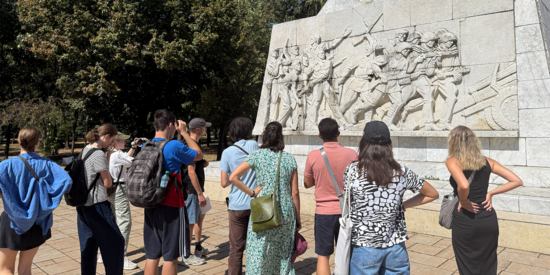

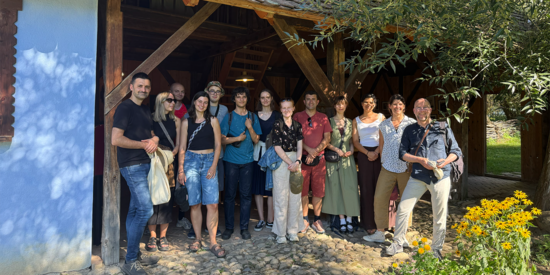
At the beginning of the autumn term of 2026, ten students of the University of Basel took part in a study trip to Romania organized by Prof. Dr. Olena Palko and Chanda Nadeem. The excursion, which was funded in part by a stipend from the Freiwillige Akademische Gesellschaft’s Fonds zur Förderung von Lehre und Forschung and supported by the Stiftung zur Förderung der ungarischen Geschichte, Kultur und Sprache, served as a counterpart to the seminar ‘Living In-Between: Borders, Identities, and Nation-Making in Eastern and South-Eastern Europe’, taught by Olena Palko in the spring term of 2026. By traveling to the Banat, Transylvania, and Szeklerland regions, students were able to trace the real-world histories and contexts behind scholarly debates on belonging, resistance, and memory in a region whose past transcends borders. Each student contributed to the study trip by preparing a brief presentation on a contested monument, which tangibly illustrated these contested histories.
The excursion began on September 2 with a guided tour of Timișoara courtesy of Alex Irimia. The city is located in Romania’s Banat region, and boasts a rich transnational history and multiethnic heritage. Additionally, it is the locale where citizens began the revolt that culminated in Nicolae Ceaușescu’s deposal and execution in 1989. The tour focused on these two aspects of Timișoara’s history, and we visited several key locations related to them. For example, Alex pointed out the bullet holes that still riddle some of the buildings in the city center following the revolution, as well as an old pharmacy whose stained-glass windows bear inscriptions in four languages.
After the tour concluded at Union Square, we listened to two student presentations about contested monuments. Georg Stark’s presentation focused on the controversies surrounding Romania’s communist heritage through the lens of the Memorial of the Unknown Soldier, located in Timișoara’s Anton von Scudier Central Park. For example, the inscription at the base of the monument was subject to change according to the ‘proper’ understanding of the communist legacy. Carmen Schlottermüller’s presentation taught us about the Capitoline Wolf statue, which stands on Victory Square and was a 1926 gift from Italy. This statue depicts a classic scene from the founding myth of Rome, in which the she-wolf (Lupa/Luperca) suckles Romulus and Remus, and serves to emphasize Romania’s Latin roots. Capitoline Wolf statues can be found in many cities across the country and we spotted several iterations throughout the excursion.
In the afternoon the group made its way to the West University of Timișoara for a conversation and Q&A with Călin Rus, the director of the Intercultural Institute of Romania. For example, we discussed the Romanian system of minority protection and how it doubles as a point of pride for nationalists, but also how ethnic and confessional diversity is framed as an asset in Timișoara.
To close out a busy first day, we visited the Memorial to the 1989 Revolution for a guided tour of their exhibition. The memorial complex provided us with an overview of the final years of Ceaușescu’s regime and contained a number of display objects from the revolutionary period. We were especially touched by the photographs of victims and the personal stories that accompanied them.
On September 3, we boarded a Flixbus from Timișoara to Sibiu. Although the journey was fairly long, it was far from boring – it was wonderful to watch the landscape change through the bus windows. The region surrounding Timișoara is quite flat and open, with golden fields, little villages, and farmland lining the roads. Once we entered Transylvania, however, the landscape shifted into lush rolling hills overgrown with dense forests and the Carpathian Mountains visible in the distance.
Sibiu, also known as Hermannstadt, was founded by Saxon settlers in the 12th century and remains the home of a small German-speaking minority to this day. In the afternoon, we had a guided tour with Cosmin Vasiu, which focused on Sibiu’s Saxon heritage. While following the tour, the group encountered a German-speaking journeyman working as a stonemason. He kindly told us about his experience as a journeyman and how the system is structured, which was fascinating. To wrap up our day, we listened to Joshua Lopez’s presentation about Samuel Brukenthal, a Habsburg governor of Transylvania whose monument stands in one of the squares of Sibiu’s old town.
In the morning of September 4, the group visited the offices of the Hermannstädter Zeitung, a weekly newspaper published in German since 1968. There, we met with the editor-in-chief Beatrice Ungar, who provided a glimpse into the newspaper’s publication history throughout the later half of the twentieth century. It was particularly interesting to see how the paper functioned under Ceaușescu’s authoritarian rule, including a name change, and how quickly local journalists shrugged off dictatorial stipulations after the Revolution in 1989. In addition to publishing their weekly newspaper, the office also concerns itself with the dissemination of German-language literature in Romania, including German-language translations of Romanian works.
That afternoon, the group paid a visit to the Democratic Forum of Germans in Romania (Demokratisches Forum der Deutschen in Rumänien). There, we were greeted by managing director Winfried Ziegler, who introduced us into the Forum’s objectives and projects. He noted the strong entanglement of history and politics in the region, which he argued makes it tricky to engage in critical historical discourse. We also learned that, due to the lack of a shared border with Germany, Austria, or Switzerland, there is no separatist or secessionist movement among the Saxon minority, which contributes to positive stereotypes surrounding them. In the evening, we transferred via public minibus to Brașov, where Prof. Dr. Benjamin Schenk joined the group.
September 5 was dedicated not to life in the cities of Transylvania, but to the history of Saxon villages in the Haferland an hour outside of Brașov. In the morning, we were met in Criţ by Prof. Dr. George-Paul Meiu (University of Basel), who kindly welcomed us in his home. After enjoying tea and coffee in his garden, it was time to explore the village. George led us uphill to the local Saxon cemetery, which doubled as a vantage point from which we could better appreciate Criţ’s layout – as is typical for Transylvanian Saxon villages, housefronts are narrow and properties extend far back rather than taking up width. This urban structure is best seen from above.
After a filling lunch of vegetable broth, sarmale and pastries, the group drove to the nearby village of Viscri. King Charles III of England owns a property in the heart of Viscri and occasionally visits, with the ‘King’s House’ and its garden doubling as a museum in his absence. At the time of our visit, the museum space was dedicated to an exhibit by artist Irina Neacșu, whose work draws heavily from the cultural landscape of Transylvania.
On September 6, the group gathered for a presentation by Sofya Maletina about the Johannes Honterus statue by Brașov’s Black Church, which was followed by a tour of the old walled city with professional historian Vlad Pasca. Vlad told us about the various religious sites in the city center, including why the Black Church bears this name – allegedly, its walls were blackened by a fire in the mid-17th century. He also showed us the monument to the 1989 revolution just outside the walled city, which marks where some of Brașov’s heaviest clashes took place.
Following the guided tour, our next stop was the Beit Israel synagogue, where we were met by representatives of the local Jewish community. Inside the synagogue, the group learned about Jewish history in Brașov, as well as hearing about the upcoming Sukkot preparations. However, the highlight of our visit was the opportunity to see a Torah potentially intended for ritual use. The scroll shown to us was one of three recently purchased by a community member after having been rediscovered in an attic not long ago. Under ordinary circumstances, we would not have been permitted to see a Torah, as the quorum of ten Jewish men was not fulfilled. However, because the scroll in question was still being appraised and had not yet been cleared for ritual use, we were permitted to see it. The story behind this Torah was fascinating and seeing it in person is something we will remember for a long time.
The group took the opportunity of a joint lunch at Sub Tâmpa to discuss the experiences of the past few days. From there, we ventured uphill for a panoramic view of Brașov and the second presentation of the day by Jara Burkhard. Some participants opted to hike uphill through the woods, while others made use of the freshly renovated cable car to reach the top. Tâmpa hill is home to Brașov’s very own Hollywood sign, but also to the fragmented pedestal of the Millennium Monument. The statue was a Hungarian memorial that stood on the hilltop for less than twenty years, during which it suffered numerous acts of vandalism by members of the local population, including a homemade bomb attack. Today, all that remains of it is a walled semicircle that formed part of its pedestal.
September 7 was a day on the road as we transferred from Brașov to Cluj-Napoca. The group’s first stop was the city of Sighișoara, the birthplace of Vlad III Țepeș (‘The Impaler’). In Sighișoara, we listened to two student presentations by Saskia Heyn and Celia Hubmann about the busts of Vlad Țepeș and Sándor Petőfi, respectively, which are both located in the fortified old town. Afterwards, students briefly had the chance to explore the city on their own over lunch, with some visiting the famous covered staircase and hilltop church overlooking the region.
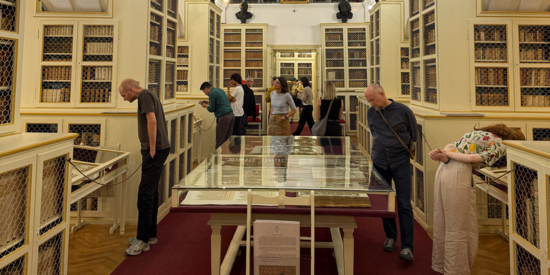
After lunch, the group continued to Târgu Mureș, where we visited the Teleki-Bolyai Library. As president Béla Haller told us, this library was the first public library on Hungarian soil, and its founder Samuel Teleki studied in Basel from 1759 to 1761. The library receives support from Switzerland to this day through the Teleki Teka Foundation-Basel, founded in 1802. We were fascinated by the many holdings on display in the stacks and the affiliated museum, including a seventeenth-century Dutch Bible translation, a hand-inked map of the British Isles, and a box of mathematician Farkas Bolyai’s teeth. Following our library visit, we attended a short tour of Târgu Mureș with Dr. Attila Kálmán, focusing in particular on the post-1989 clashes that took place in the city center. Although our time in Târgu Mureș was brief, many participants were eager to learn more about the city’s history and hope to return in the future.
Our last stop on September 7 took us to Gornești’s Teleki Castle, an imposing Baroque structure that served as a children’s tuberculosis preventorium under communist rule. The group was greeted by owners Nicole Foldvary and Kálman Teleki, who led us on a tour through the castle. The building, restituted to the Teleki family in 2011, recently underwent extensive restoration work and now houses a museum as well as being a prime location for events and photoshoots. The owners took us behind the scenes and into the castle’s attic, where we were able to see the structure of the roof from within. Our visit to Teleki Castle ended with a lovely barbecue in the gardens, after which the group drove on to Cluj.
The morning of September 8 was dedicated to the last city tour of the trip. Dr. Ana-Maria Stan guided us through downtown Cluj, paying particular attention to the various schools and university buildings in the city’s center. We also made some stops along the way to listen to the final student presentations by Chanda Nadeem, Raghib Anjavi, and Jonatan Mangold about the Scoala Ardeleana monument, the statue to St. George outside Cluj’s Lutheran church, and the Matthias Corvinus monument group, respectively. Following the tour, the group paid a visit to the University of Arts and Design with lecturer Dr. Dragoș Sdrobiș, located at Casa Matei. The university building is the birthplace of Matthias Corvinus, one of the most important kings of Hungary.
After a lunch break and a visit to the privately owned Muzeon, where participants heard personal stories of the Holocaust in Romania through the lens of the history of the Lusztig family from Cluj, the group walked to Casa Tranzit, a former synagogue that now serves as a cultural center. There, we met with Dan and Lorena Doghi to learn about the Roma community. Dan served as the OSCE ODIHR’s Chief of Contact Point for Roma and Sinti Issues and founded the NGO Centre for Roma Rights, Memory, and Participation. The Roma minority, although it is easily one of the largest in Romania, had been a near-total blind spot in our discussions and tours thus far, and we were grateful for the opportunity to speak with them. For example, we learned that the Romanian legal framework is less discriminatory than the reality lived by the Roma; however, there is a significant discrepancy between what is legally enshrined and what is actually enforced. For many of us, this meeting was among the most engaging and eye-opening of the entire excursion, and the discussion among the group continued over that evening’s joint dinner.
September 9 was our last day in Cluj and our last full day in Romania. That morning, we visited the Romanian Institute for Research on National Minorities (ISPMN), where we met with researchers Anca Filipovici, László Fosztó, and István Székely. They introduced us to the institute and their respective projects, which pertain to the Roma and Hungarian minorities in Romania. We also had the chance to peruse some of the institute’s most recent publications. Anca joined us for the next stop on our itinerary, Cluj’s Neolog Synagogue. There, the group met with representatives of the Jewish community, who told us about the history of Jews in Cluj and the work they do for their peers.
In the afternoon, we toured the Museum of the Holocaust in Northern Transylvania with Dr. Gelu Păcurar, where we watched a short documentary about the impact of the Holocaust in the region. The museum, though small, is home to several poignant displays that showcase local stories of loss and survival. The neighboring building is home to the Kriza János Ethnographic Society, which was the final academic point on our itinerary. The recently renovated building houses an extensive library and archive of materials pertaining to the Hungarian minority in Transylvania and Romania, and participants were able to wander the stacks to appreciate the different holdings.
That evening, we traded academics for culture and attended a musical performance of Ada Milea’s “Songs That Scare Away Fear” at the Studio Euphorion theater. The play, based on the writings of Herta Müller, stressed the importance of language as a means of resistance in the face of oppression. We all greatly enjoyed the performance and felt it was a fitting conclusion to the study trip. On September 10, the group bade a fond farewell to Romania and went their respective ways.
Report by Saskia Esther Heyn, Photos by Chanda Nadeem